How to Choose a Reliable Disposable Pop Up Timer Supplier: A Procurement Checklist for Global Buyers
How to Choose a Reliable Disposable Pop Up Timer Supplier: A Procurement Checklist for Global Buyers
Selecting the right disposable pop up timer supplier is an important decision for food manufacturers, distributors and international buyers. Although the product itself is small, supplier reliability directly affects production stability, product quality and long-term business performance.
Many companies compare suppliers only by price. However, experienced procurement teams evaluate much more than cost. Manufacturing capability, quality consistency, customization support and export experience are all important factors when choosing a long-term partner.
This procurement checklist explains the key factors global buyers should consider before selecting a disposable pop up timer manufacturer.
Why Supplier Selection Matters for Disposable Pop Up Timers
Disposable pop up timers are used in professional food applications where consistency is essential. Poultry processors, meat manufacturers and food brands often purchase large quantities that must perform reliably across thousands of products.
A supplier problem can create unnecessary risks, including:
- Unstable product quality
- Delayed shipments
- Inconsistent specifications
- Limited customization options
- Communication difficulties
Choosing the right manufacturer helps companies create a more reliable and efficient supply chain.
1. Check Whether the Supplier Is a Real Manufacturer
One of the first questions buyers should ask is whether the supplier is an actual factory or simply a trading company.
A direct manufacturer usually has:
- Production facilities
- Manufacturing equipment
- Quality control procedures
- Product development capability
- Technical production knowledge
For long-term B2B cooperation, direct factory relationships often provide better communication and supply transparency.
2. Evaluate Product Specialization
Disposable pop up timers are a specialized product category. A supplier focusing only on this product usually develops deeper manufacturing experience than a company selling many unrelated products.
Specialized manufacturers understand:
- Temperature activation technology
- Material selection
- Production consistency
- Application requirements
- OEM customization
Product specialization is often a strong indicator of technical capability.
3. Review Manufacturing Experience
Experience matters because manufacturing knowledge develops over time.
An experienced supplier usually has better understanding of:
- Customer requirements
- International standards
- Quality control processes
- Export procedures
- Large-volume production management
For procurement teams, long-term manufacturing experience can reduce sourcing risks.
4. Confirm Material and Product Specifications
Professional buyers should always understand the technical specifications before purchasing.
Important evaluation points include:
- Housing and component materials
- Food contact suitability
- Temperature activation range
- Activation accuracy
- Product dimensions
- Packaging requirements
For food applications, suppliers should clearly explain material information and production standards.
5. Evaluate Quality Control Capability
Consistent quality is essential for bulk purchasing.
A reliable supplier should have processes covering:
- Incoming material inspection
- Production monitoring
- Temperature testing
- Final product inspection
- Batch consistency control
Quality control becomes increasingly important as order quantities increase.
6. Check OEM and Customization Capability
Many professional buyers require customized products instead of standard models.
A capable OEM supplier should support:
- Custom activation temperature
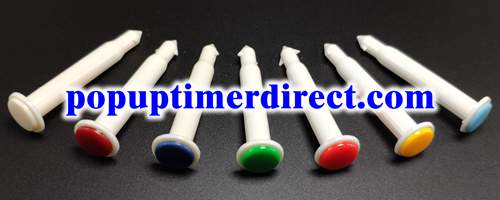
- Custom button colors
- Logo injection on button head
- Private label solutions
- Customized packaging
Customization capability allows brands and distributors to create products suited to their own markets.
7. Consider Export Experience
International buyers need suppliers who understand global business requirements.
Export experience includes:
- International communication
- Export documentation
- Packaging requirements
- Shipping coordination
- Overseas customer support
A manufacturer experienced in international markets can make the purchasing process smoother.
8. Understand Production Capacity and Supply Stability
For distributors and food manufacturers, supply continuity is critical.
Buyers should evaluate:
- Monthly production capability
- Ability to handle large orders
- Seasonal demand support
- Repeat order management
A reliable supplier should be able to support both current demand and future growth.
Disposable Pop Up Timer Supplier Evaluation Checklist
| Evaluation Area | Questions Buyers Should Ask |
|---|---|
| Manufacturer Status | Is the supplier a direct factory? |
| Experience | How long have they specialized in this product? |
| Materials | Are product materials clearly specified? |
| Quality | How is production consistency controlled? |
| Customization | Can they support OEM requirements? |
| Export | Do they serve international buyers? |
Why Direct Factory Partnerships Create Long-Term Value
A reliable disposable pop up timer supplier should be more than a product source. The best partnerships combine manufacturing expertise, technical support and consistent supply.
For companies purchasing repeatedly, direct factory cooperation helps improve:
- Communication efficiency
- Product consistency
- Customization flexibility
- Supply planning
- Cost management
Frequently Asked Questions
1. How do I find a reliable disposable pop up timer supplier?
Buyers should evaluate manufacturing capability, product specialization, quality control, customization support and export experience.
2. Should I buy from a factory or trading company?
For large-volume B2B orders, direct factory cooperation often provides better control over quality, customization and supply.
3. How can I verify a pop up timer manufacturer?
Review manufacturing experience, production capability, certifications, product information and customer service capability.
4. What information should I provide when requesting a quotation?
Buyers should provide quantity, temperature requirement, packaging needs, application and customization requirements.
5. Can suppliers provide samples before bulk orders?
Professional manufacturers usually provide samples for specification confirmation before production.
6. What certifications should food companies consider?
Food companies commonly evaluate FDA, EU and BRC-related compliance requirements.
7. Why is supplier specialization important?
Specialized suppliers usually have deeper product knowledge and stronger manufacturing capability.
Conclusion: Choosing the Right Manufacturing Partner
Selecting a disposable pop up timer supplier is a strategic sourcing decision. The right partner should provide stable manufacturing, reliable quality, flexible customization and professional export support.
For global food companies, building a direct relationship with a specialized manufacturer can create long-term advantages in supply reliability and product development.
DISCLAIMER: "Pop-Up Timer" is a generic industry term describing disposable cooking temperature indicators. PopNReady is an independent Chinese direct-source manufacturer specializing in disposable pop up timers and pop-up disposable cooking thermometers. We are not affiliated with VOLK or any other third-party brands. Any references to brands are provided only for identification and comparison purposes.