How to Choose the Right Activation Temperature for a Disposable Pop Up Timer
How to Choose the Right Activation Temperature for a Disposable Pop Up Timer
Choosing the correct activation temperature is one of the most important decisions when specifying a disposable pop up timer for a food product. The temperature setting affects how the indicator responds during cooking and whether it is suitable for the intended application.
For food manufacturers, poultry processors, private label brands and distributors, the right selection should be based on the product application rather than simply choosing the most commonly used temperature.
This guide explains the main factors B2B buyers should consider when selecting an activation temperature for a disposable cooking temperature indicator.
What Does Activation Temperature Mean?
The activation temperature is the designed temperature point at which a disposable pop up timer releases its internal mechanism and produces a visible pop-up indication.
It is different from a conventional digital thermometer that continuously displays the measured temperature. A disposable temperature indicator is designed around a specific activation point and provides a simple visual signal when that point is reached.
This makes activation temperature one of the primary specifications buyers should confirm before placing a bulk order.
Why Activation Temperature Selection Matters
Different food products and processing conditions may require different temperature indication requirements. Selecting an unsuitable activation temperature can make the product less useful for the intended application.
For commercial buyers, temperature selection can affect:
- Product application
- Cooking and processing requirements
- Consumer expectations
- Product positioning
- OEM specification
- Final packaging information
The correct specification should therefore be determined before production rather than treated as a minor packaging decision.
Common Activation Temperature Options
Disposable pop up timers can be manufactured with different activation temperature specifications for different applications.
Common temperature options may include approximately 125°F, 138°F, 145°F, 160°F, 165°F, 170°F, 180°F and 185°F, depending on the product design and manufacturing specification.
The availability of multiple temperature settings allows manufacturers and OEM customers to select a product that better matches their intended application.
The exact temperature specification should always be confirmed with the manufacturer before production, particularly when developing a customized product.
How Product Type Influences Temperature Selection
The first question a buyer should ask is not simply "Which temperature is most popular?" but rather "What food product and process will this indicator be used for?"
Relevant factors can include:
- Type of meat or poultry
- Product size
- Cooking method
- Processing conditions
- Customer specification
- Intended market
A turkey product, for example, may have different requirements from a smaller poultry product or a prepared food application.
Turkey and Poultry Applications
Turkey and poultry products represent important applications for disposable pop up timers.
For these applications, buyers may need to consider product weight, cooking method and the intended temperature indication point when selecting a specification.
Large commercial poultry processors and private label food manufacturers should also consider whether the selected temperature specification can be maintained consistently across repeated production batches.
Does Product Size Matter?
The physical size of a disposable pop up timer can also be relevant to product selection.
Different food products may have different available installation areas, packaging formats and visual presentation requirements.
For this reason, buyers may need to consider both activation temperature and physical size rather than treating temperature as an independent specification.
A suitable product should fit the application mechanically while providing the required temperature indication.
Temperature Selection for OEM Projects
OEM projects often require more detailed specification discussions than standard bulk purchases.
A buyer developing a private label product may need to define:
- Activation temperature
- Product size
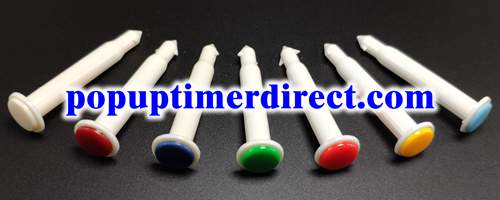
- Button color
- Product identification
- Packaging format
- Required order quantity
Defining these specifications before production helps reduce misunderstandings and makes the manufacturing process more predictable.
Do Not Select a Temperature Based Only on Marketing Claims
A common purchasing mistake is to select a temperature indicator based only on a general statement that a particular temperature is suitable for a certain food.
Commercial food production is more complicated than a single temperature number. Processing equipment, product configuration, cooking conditions and customer requirements can all influence the appropriate specification.
The activation temperature should therefore be treated as a product specification that needs to be evaluated within the actual application.
What B2B Buyers Should Confirm With a Manufacturer
Before ordering a disposable pop up timer in bulk, procurement teams should confirm several details with the manufacturer.
- Available activation temperatures
- Activation accuracy
- Product dimensions
- Materials
- Packaging options
- OEM customization capability
- Minimum order quantity
- Production lead time
For customized projects, buyers should also request samples when appropriate so that the product can be evaluated under the intended application conditions.
Why Consistency Is as Important as the Temperature Setting
Selecting the correct nominal activation temperature is only the first step. For commercial applications, consistency between products and production batches is equally important.
A manufacturer should have appropriate production controls for materials, components, assembly and activation performance.
For distributors and food manufacturers purchasing large quantities, stable batch-to-batch performance can be more valuable than a small difference in unit price.
A Practical Specification Checklist
A simple specification checklist can make the sourcing process more efficient.
| Specification | What the Buyer Should Confirm |
|---|---|
| Activation Temperature | Does the temperature match the intended application? |
| Accuracy | What activation tolerance is specified? |
| Size | Will the indicator fit the intended product? |
| Materials | Are the materials suitable for the intended food application? |
| Packaging | Is bulk, OEM or retail packaging required? |
| Customization | Are color, logo or other specifications required? |
| Supply | Can the manufacturer support the required volume? |
Frequently Asked Questions
1. What is the activation temperature of a disposable pop up timer?
It is the designed temperature point at which the internal mechanism activates and produces a visible pop-up indication.
2. Can disposable pop up timers have different activation temperatures?
Yes. Different temperature specifications are available for different food applications and OEM requirements.
3. How should a buyer choose the activation temperature?
The selection should be based on the food product, processing conditions, application requirements and customer specifications.
4. Can activation temperature be customized for an OEM project?
Yes. Customized activation temperatures can be discussed with a qualified manufacturer according to the project requirements.
5. Does the size of the pop up timer matter?
Yes. Physical dimensions should be considered together with activation temperature to ensure the product is suitable for the intended application.
6. Should buyers test samples before a bulk order?
For new applications or customized projects, sample evaluation is a practical way to confirm suitability before committing to large-volume production.
7. Is the lowest-cost temperature indicator always the best choice?
No. Buyers should consider activation performance, consistency, materials, manufacturing capability and long-term supply reliability in addition to price.
Conclusion: Choose the Specification Before Choosing the Supplier
The right disposable pop up timer begins with the right specification. Activation temperature should be selected according to the actual food application rather than simply based on a generic product description.
For professional buyers, the best approach is to define the required temperature, size, materials, packaging and volume first, then evaluate manufacturers based on their ability to produce those specifications consistently.
This approach makes product sourcing more precise and provides a stronger foundation for long-term B2B cooperation.
DISCLAIMER
"Pop-up timer" is a commonly used descriptive industry term for a type of disposable cooking temperature indicator. It may refer to the functional design or operating principle of such products and does not by itself identify a specific manufacturer or brand.
PopNReady™ is an independent OEM brand of disposable cooking temperature indicators manufactured by LIOU Manufacturing . We are an independent factory-direct manufacturer and are not affiliated with any other brand or manufacturer unless expressly stated.