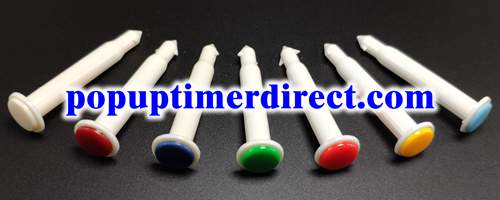
What Should Buyers Confirm Before Ordering Disposable Pop Up Timers in Bulk?
What Should Buyers Confirm Before Ordering Disposable Pop Up Timers in Bulk?
Buying disposable pop up timers in bulk is different from purchasing a small quantity for occasional use. For food manufacturers, poultry processors, distributors, importers and private label brands, the product specification and supplier capability both need to be evaluated before a purchase order is placed.
A low unit price may look attractive at the beginning, but long-term B2B supply depends on much more than price. Product consistency, activation temperature, materials, packaging, customization, production capacity and communication all become important when an order involves thousands or hundreds of thousands of pieces.
This guide provides a practical checklist for buyers who are evaluating disposable pop-up timers for bulk purchasing.
Start With the Application, Not the Supplier
The first step should be defining how the disposable temperature indicator will actually be used.
Before contacting manufacturers, buyers should identify the intended food product and application. This may include turkey, chicken, other poultry, meat products, prepared foods or commercial food production.
The application helps determine which specifications need to be discussed with the supplier.
- Food product and application
- Required activation temperature
- Preferred product size
- Installation method
- Packaging format
- Estimated annual or recurring quantity
- OEM or private label requirements
A clearly defined application makes supplier evaluation much more efficient.
1. Confirm the Exact Product Specification
Before discussing price, buyers should make sure both sides are referring to the same product.
A disposable pop up timer can vary in activation temperature, physical dimensions, materials, button color and packaging. These differences can affect both suitability and final cost.
A basic product specification should therefore identify the following:
- Product type
- Activation temperature
- Activation accuracy
- Physical size
- Materials
- Button or indicator color
- Packaging
Written specifications reduce the possibility of misunderstandings when a project moves from quotation to production.
2. Confirm the Activation Temperature
Activation temperature is one of the most important specifications for a disposable temperature indicator.
Different applications may require different activation points. Buyers should not assume that one temperature is suitable for every poultry, meat or food product.
Depending on the product design and manufacturing specification, available activation temperatures may include options such as 125°F, 138°F, 145°F, 160°F, 165°F, 170°F, 180°F and 185°F.
The appropriate specification should be selected according to the intended application and confirmed with the manufacturer before production.
3. Ask About Activation Accuracy
A nominal activation temperature alone does not provide enough information for a professional purchasing decision. Buyers should also ask how activation accuracy is specified and controlled.
For commercial food applications, consistency between individual products and production batches can be important.
A supplier should be able to explain its stated activation tolerance and the production controls used to maintain consistent performance.
4. Confirm the Materials
Material information is particularly important when a disposable temperature indicator is intended for food applications.
Buyers should ask what materials are used for the housing, internal components and temperature-sensing element.
A professional specification may include information such as:
- Food-grade PA66 components
- BPA-free design
- Temperature-sensing material
- Metal spring structure
The exact material specification should be documented for the particular product being purchased rather than assumed from a generic product description.
5. Confirm the Packaging Requirement
Packaging can be a major part of a bulk disposable pop up timer project, particularly when the product will eventually be sold under another company's brand.
Depending on the application, buyers may require:
- Bulk loose packing
- Transparent bag packaging
- Blister card packaging
- Display box packaging
- Private label packaging
Packaging requirements should be discussed before the quotation is finalized because they can affect tooling, materials, labor and production lead time.
6. Determine Whether OEM Customization Is Required
Not every bulk order is an OEM order. Some distributors simply need standard products, while food brands may require customized specifications and packaging.
For an OEM project, buyers should clarify whether they need:
- Custom activation temperature
- Custom color
- Logo identification
- Custom packaging
- Private label presentation
The earlier these requirements are defined, the easier it is for the manufacturer to provide an accurate quotation and production plan.
7. Ask About Manufacturing Experience
A supplier's experience with the specific product category is worth evaluating separately from its general trading or exporting experience.
Disposable pop-up timers involve temperature-sensitive components, mechanical parts, molding and assembly. A manufacturer that specializes in this product can develop more focused production knowledge than a general supplier that handles many unrelated products.
For a long-term B2B project, buyers should ask how long the supplier has specialized in disposable pop-up timers and temperature indicators.
8. Verify Whether the Supplier Is a Manufacturer or Intermediary
Buyers should also establish who is actually responsible for manufacturing the product.
A trading company, distributor and direct manufacturer may all offer similar-looking products, but their capabilities can be different.
For direct factory sourcing, useful questions include:
- Who manufactures the product?
- Where is the product manufactured?
- Who controls production quality?
- Who handles customization?
- Who is responsible for production scheduling?
Clear answers are particularly important for customized and recurring orders.
9. Evaluate Bulk Production Capability
A supplier may be able to provide samples without necessarily having the production capability required for a large recurring order.
For bulk purchasing, buyers should discuss:
- Monthly production capability
- Current production schedule
- Minimum order quantity
- Typical lead time
- Capacity for repeat orders
This is especially important for food manufacturers whose production schedules depend on continuous availability of packaging and product components.
10. Confirm Export and Documentation Capability
International B2B purchasing involves more than manufacturing. Export experience can also affect the efficiency of the transaction.
Overseas buyers may need to discuss:
- Commercial documentation
- Packaging information
- Product specifications
- Food-contact or compliance documentation where applicable
- Shipping arrangements
A supplier familiar with international B2B transactions can make communication and documentation more straightforward.
11. Request Samples for New Applications
Samples can be particularly useful when the product is being introduced into a new food application or when an OEM specification has been developed.
Sample evaluation can help buyers check:
- Physical dimensions
- Appearance
- Installation suitability
- Packaging
- Activation performance under the intended application
For a large production order, confirming the specification before mass production can reduce unnecessary risk.
12. Compare Suppliers on Total Supply Value
The lowest quoted unit price does not necessarily represent the lowest overall purchasing cost.
A useful comparison should consider:
| Evaluation Factor | Why It Matters |
|---|---|
| Unit Price | Determines the direct product cost |
| Product Consistency | Helps reduce quality-related problems |
| MOQ | Affects inventory and purchasing flexibility |
| Lead Time | Affects production and inventory planning |
| OEM Capability | Important for customized products |
| Production Capacity | Supports stable long-term supply |
| Packaging Capability | Important for private label and retail projects |
| Export Experience | Helps simplify international purchasing |
Looking at the complete supply relationship gives buyers a more realistic basis for comparing manufacturers.
A Simple Bulk Purchasing Checklist
Before placing a bulk order, a procurement team can use the following checklist:
- Define the food application.
- Confirm the activation temperature.
- Confirm the required accuracy.
- Confirm product dimensions.
- Review material specifications.
- Choose the required packaging.
- Define OEM requirements if applicable.
- Confirm MOQ and production capacity.
- Discuss lead time.
- Review relevant compliance documentation.
- Evaluate samples for new applications.
- Confirm the manufacturer's responsibility for production.
Having these points clearly defined before ordering makes the sourcing process more transparent and reduces avoidable problems later.
Frequently Asked Questions
1. What should I ask a disposable pop up timer supplier before ordering in bulk?
Buyers should confirm product specifications, activation temperature, accuracy, materials, packaging, MOQ, production capacity, lead time and OEM capability.
2. Should I choose a manufacturer or a trading company?
The appropriate choice depends on the project, but direct manufacturers can provide closer access to production, customization and technical information.
3. What is the most important specification for a disposable pop up timer?
Activation temperature is one of the most important specifications, but it should be evaluated together with accuracy, size, materials and application requirements.
4. Can bulk orders include custom packaging?
Yes. Depending on the project, bulk orders can be supplied with customized packaging or private label packaging.
5. Can activation temperature be customized?
Custom activation temperatures can be discussed for OEM projects according to the intended application and manufacturing requirements.
6. Should buyers request samples before a large order?
For new products, customized specifications or unfamiliar applications, sample evaluation is generally a sensible step before committing to large-volume production.
7. Why is production capacity important for a bulk buyer?
A supplier needs sufficient capacity to support the required initial quantity as well as future repeat orders.
8. Is price the most important factor when selecting a bulk supplier?
No. Product consistency, production capability, customization, lead time and long-term supply reliability should also be considered.
Conclusion: A Good Bulk Order Starts With Clear Specifications
Successful bulk sourcing of disposable pop up timers begins before the purchase order is issued. Buyers should first define the application and product specifications, then evaluate whether a supplier has the manufacturing experience, production capability and customization resources required for the project.
For food manufacturers, poultry processors, distributors and OEM brands, this approach creates a clearer purchasing process and makes it easier to build a dependable long-term supply relationship.
The goal is not simply to find a supplier that can ship a quantity of products. The goal is to find a manufacturing partner that can consistently produce the required specification and support the application as the business grows.
DISCLAIMER
"Pop-up timer" is a commonly used descriptive industry term for a type of disposable cooking temperature indicator. It may refer to the functional design or operating principle of such products and does not by itself identify a specific manufacturer or brand.
PopNReady™ is an independent OEM brand of disposable cooking temperature indicators manufactured by LIOU Manufacturing . We are an independent factory-direct manufacturer and are not affiliated with any other brand or manufacturer unless expressly stated.